In our opinion at Kingwell Immigration Law, the main Canadian citizenship by descent benefits are:
If you inherit citizenship through a Canadian parent, you are a citizen by operation of law. You do not need to pass a citizenship test, meet a residency requirement, or pay the CAD $653.00 adult citizenship grant fee.
Your rights begin the moment your eligibility is established, not the day a certificate arrives. The eight benefits below are the ones our clients ask about most.
Speak to a Canada citizenship lawyer in Toronto at our firm to confirm your descent eligibility.
Citizenship by descent skips every requirement that naturalization applicants must meet. You will not need to be a permanent resident, accumulate days of physical presence in Canada, sit a citizenship test, demonstrate language ability, or attend a ceremony.
The contrast is significant. A naturalization applicant typically needs three years of physical presence as a permanent resident in the five years before applying, must pass a knowledge test in English or French, and pays the adult grant fee of CAD $653.00.
A person who qualifies by descent already holds citizenship, and the application is for proof, not for a grant. This matters most for clients who have never lived in Canada or whose work keeps them outside the country.
The official Government of Canada eligibility tool can flag obvious cases. Borderline files are where our team adds the most value, by interpreting your family record against the current rules.
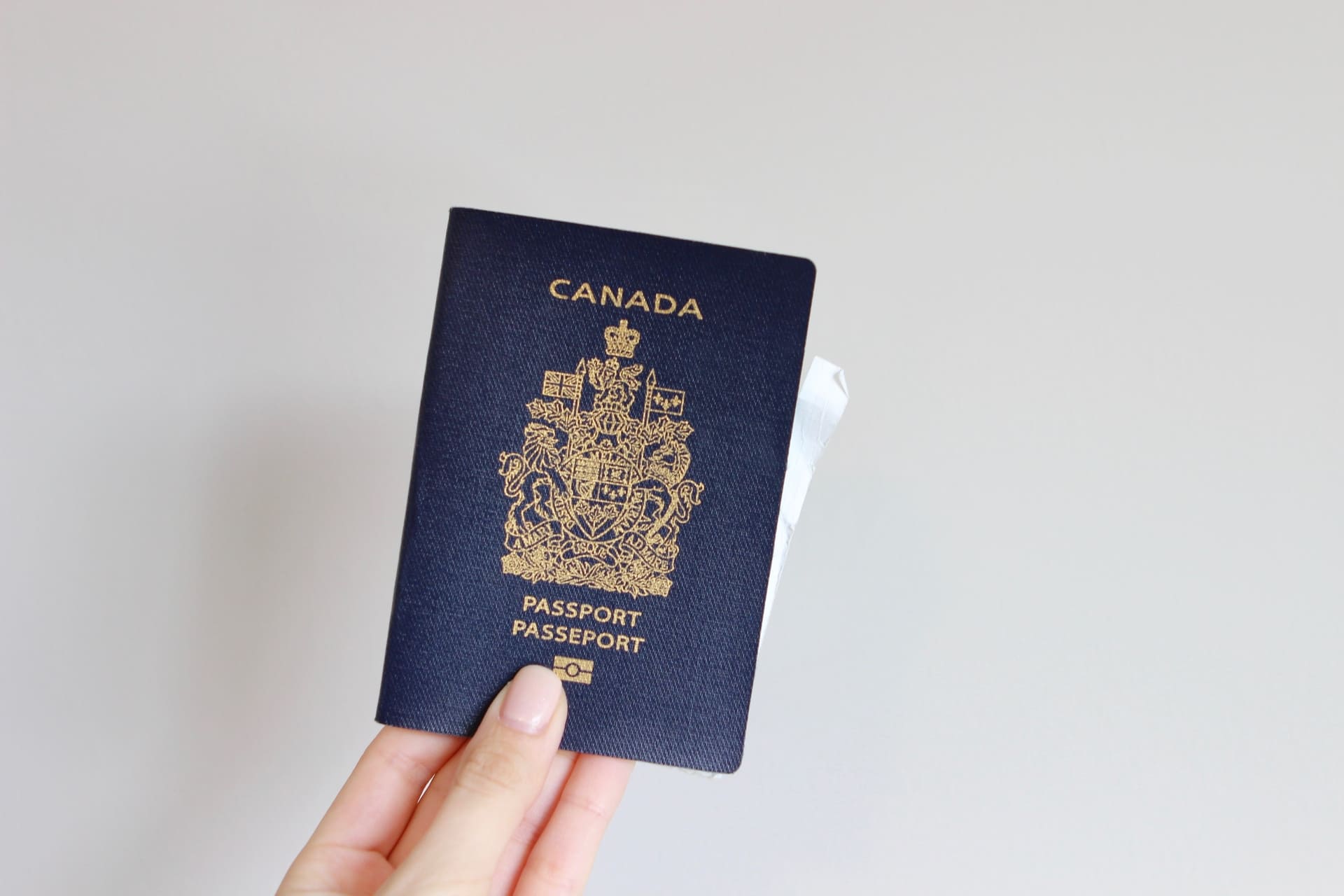
Once IRCC confirms your citizenship, you can apply for a Canadian passport in the same way as any other citizen. The Canadian passport is consistently ranked among the world’s strongest travel documents, with visa-free or visa-on-arrival access to a wide range of countries.
For clients who hold a less-mobile passport as their primary travel document, this is often the most immediate benefit of confirming descent eligibility. It also provides consular support from Canadian embassies and consulates abroad in emergencies, which can be a meaningful protection for clients living or travelling in unstable regions.
As a Canadian citizen by descent, you have an unqualified right to enter Canada and to live, work, and study here at any time. There is no work permit, study permit, visitor visa, or temporary status required.
You also do not have to maintain a residency obligation the way permanent residents do. This benefit becomes particularly valuable for clients who want to keep options open across borders.
A descent citizen can spend years abroad, return to Canada whenever they choose, and pick up work or studies without applying to IRCC for permission. Permanent residents, by contrast, must meet the 730-day physical presence requirement across every five-year period or risk losing their status.
For families with children approaching post-secondary education, descent citizenship also means access to domestic tuition rates at Canadian universities and colleges. This is a substantial cost saving over international student rates.
Canada permits dual and multiple citizenship. When you confirm citizenship by descent, you do not have to renounce any other nationality you currently hold, provided your other country of citizenship also allows it.
This is one of the most practical benefits because it preserves existing family, business, and property ties in the country where you currently live. For example, a person born in Italy to a Canadian-born parent could, in principle, hold both Canadian and Italian citizenship without restriction from the Canadian side.
A small number of countries restrict or prohibit dual citizenship, particularly where civil service, military service, or political office is involved. Our team will walk you through how your other nationality interacts with Canadian citizenship by descent.
Have a question about your eligibility? Book a consultation with our team.
Canadian citizens have the right to vote in federal, provincial, and municipal elections, and to run for political office. These rights are not extended to permanent residents, regardless of how long they have lived in Canada.
Beyond voting, descent citizens are fully protected by the Canadian Charter of Rights and Freedoms. This includes mobility rights under section 6 of the Charter, specifically the right to enter, remain in, and leave Canada.
These rights cannot be revoked the way permanent resident status can be revoked for failure to meet residency obligations. The practical effect is that a citizen by descent has the same constitutional protection as any Canadian-born citizen, even if they have never set foot in Canada.
Bill C-3 received Royal Assent on November 20, 2025, and came into force on December 15, 2025. It removed the first-generation limit that, since 2009, had blocked Canadian parents born abroad from passing citizenship to their children also born abroad.
The full framework is set out in the Government of Canada’s citizenship rule changes for 2025. For people born or adopted outside Canada before December 15, 2025 in the second generation or later, the change is retroactive.
If you had a Canadian parent at the time of your birth or adoption, you may now be a citizen automatically. This restored citizenship to many people previously identified as “Lost Canadians” and their descendants.
For people born or adopted outside Canada on or after December 15, 2025 to a Canadian parent who was also born abroad, citizenship passes only if the Canadian parent has a substantial connection to Canada. The test is 1,095 cumulative days of physical presence in Canada before the child’s birth or adoption.
💡 Additional reading: Canadian citizenship new eligibility

As a Canadian citizen by descent, you can sponsor your spouse, common-law partner, conjugal partner, and dependent children for permanent residence in Canada. You may also be eligible to sponsor parents and grandparents through the Parents and Grandparents Program when intake is open.
Citizenship gives you sponsorship eligibility that a non-citizen partner abroad would not have. You can also pass Canadian citizenship to your own children.
For children born or adopted abroad before December 15, 2025, this passes automatically under the retroactive provisions of Bill C-3. For children born or adopted on or after that date, transmission depends on whether you meet the 1,095-day substantial connection test.
The Government of Canada page on children born outside Canada sets out the proof-of-citizenship requirements that follow. The generational reach of descent is one of the reasons clients come to us even when no immediate move to Canada is planned.
💡 Additional reading: benefits of marrying a Canadian citizen
Citizenship by descent applicants have the right to challenge a wrongful IRCC decision in the Federal Court of Canada. This is a meaningful protection, because proof-of-citizenship applications are not always straightforward.
Records can be incomplete, particularly for older births, adoptions, or naturalizations that happened outside Canada. IRCC officers can also reach incorrect conclusions about eligibility, particularly in second-generation and Bill C-3 cases.
Daniel Kingwell, the founder of our firm, has over 20 years of immigration law experience and Federal Court litigation capability. This is a meaningful differentiator over Regulated Canadian Immigration Consultants, who cannot appear in Federal Court.
Among the firm’s Federal Court results:
Judicial review deadlines run quickly, sometimes as short as 15 days under the Federal Courts Act. Our litigation team moves immediately to assess refused descent files and file within the statutory window where the merits support it.
The table below shows why descent is a fundamentally different route to citizenship. The benefits arrive without the requirements that naturalization imposes.
Requirement | Citizenship by descent | Citizenship by naturalization |
Permanent residence first | Not required | Required |
Physical presence in Canada | Not required for the applicant | 1,095 days in the past five years |
Citizenship test | Not required | Required (ages 18 to 54) |
Language requirement | Not required | English or French (ages 18 to 54) |
Application fee (adult) | Proof of citizenship fee | CAD $653.00 grant fee |
Citizenship ceremony | Not required | Required |
Source of citizenship | Inherited by law | Granted by IRCC decision |
💡 Additional reading: benefits of Canadian citizenship
The benefits of citizenship by descent are wide-reaching, but each case turns on the specific facts of the parent’s status, the dates and locations of births and adoptions, and the documentary record available. Several considerations come up regularly in our practice.
Paper submission to Sydney, Nova Scotia. Most Bill C-3 descent applicants are required to submit by paper to the federal processing centre in Sydney, NS. This is a requirement, not a preference, and processing times reflect the transition to the new framework.

Our lawyers act as our clients’ pillar of strength, investing ourselves in the facts of your file and in the goals you have for your family in Canada. We assess descent eligibility on the facts of your family record, identify which framework applies, and prepare an application designed to anticipate the questions an IRCC officer will ask.
We never apply a one-size-fits-all approach. Where a refusal has already been issued, our litigation team weighs the merits of judicial review and acts within the applicable deadlines.
If your family record points to Canadian citizenship by descent, our team will help you confirm your status, secure your certificate, and protect the rights that follow from it.
Call 416.988.8853 or book a consultation with us to discuss your descent eligibility.
IRCC processing times for proof-of-citizenship applications currently range widely because of the Bill C-3 transition that began on December 15, 2025. Our team tracks the current IRCC benchmarks weekly and gives every client a realistic timeline for their specific file before any application is submitted.
Yes, every person needs their own proof-of-citizenship application, including each of your children, even where the underlying eligibility evidence overlaps. Our lawyers prepare family files in parallel so the supporting documents stay consistent and IRCC reaches the same finding for each member of your family.
Missing parental records are recoverable in most cases. We source evidence from provincial vital statistics offices, Library and Archives Canada, and parish or church registries to rebuild a missing file, and pursue judicial review in Federal Court where IRCC refuses despite reasonable evidence of eligibility.
No, Canada permits dual and multiple citizenship, so claiming Canadian status does not affect your other nationality under Canadian law. The risk, if any, comes from the law of your other country, especially for civil servants, military personnel, or politicians, and we will flag where outside legal advice is needed.
A valid Canadian passport is required, because Canadian citizens, including children, must board a flight to Canada on a Canadian passport, not on a foreign passport with a visa. Our team sequences the citizenship certificate and passport applications so your family’s travel timelines stay realistic.