
Outland spousal sponsorship is how a Canadian citizen or permanent resident sponsors their spouse, common-law partner, or conjugal partner for Canadian permanent residence when that person is living outside Canada.
The outland process is handled by the visa office that serves the sponsored person’s country of citizenship or country of legal residence. Both the sponsor and the sponsored person must be approved by Immigration, Refugees and Citizenship Canada (IRCC) before a permanent resident visa is issued.
At Kingwell Immigration Law, we work with couples across Canada and around the world on this process, which is the default path under the Immigration and Refugee Protection Act (IRPA), distinct from the inland route that requires both partners to already be living together in Canada.
Speak with our Canada sponsorship lawyer to discuss your case.
To be eligible to sponsor a spouse, common-law partner, or conjugal partner under the outland category, the sponsor must meet a number of requirements set out under IRPA and its regulations. The sponsor must:
Quebec residents must also meet the province’s own immigration requirements and complete a separate undertaking with the provincial government before a final decision is made. If you are unsure whether your circumstances meet the sponsorship eligibility requirements, we can review your situation before you commit to a filing strategy.

The sponsored person must fall into one of three relationship categories recognized under Canadian immigration law:
Both parties must be at least 18 years of age. Where the relationship category is unclear or the evidence of cohabitation or commitment is thin, we can advise on how the application should be framed before it is submitted.
💡 Additional reading: Canada spousal sponsorship permanent residence requirements
Book a consultation to get clarity on your sponsorship options.
An outland sponsorship application requires documentation from both the sponsor and the sponsored person. The exact documents vary depending on the relationship type, the countries involved, and the individual circumstances of the couple.
The IRCC application guide includes a detailed checklist. In general, the application will require:
The strength and consistency of the relationship evidence is the single most scrutinized element of a spousal sponsorship application. We work with clients to identify gaps in their documentation before the application is filed, so the file going to IRCC is as complete and coherent as possible from the outset.
💡 Additional reading: inland spousal sponsorship
IRCC charges application fees to process an outland spousal sponsorship. The total government fee is $1,205, with the current fee breakdown available directly from IRCC’s fees page.
Fees are subject to change, and biometric fees may apply depending on the applicant’s circumstances. Legal fees for professional representation are separate from government fees.
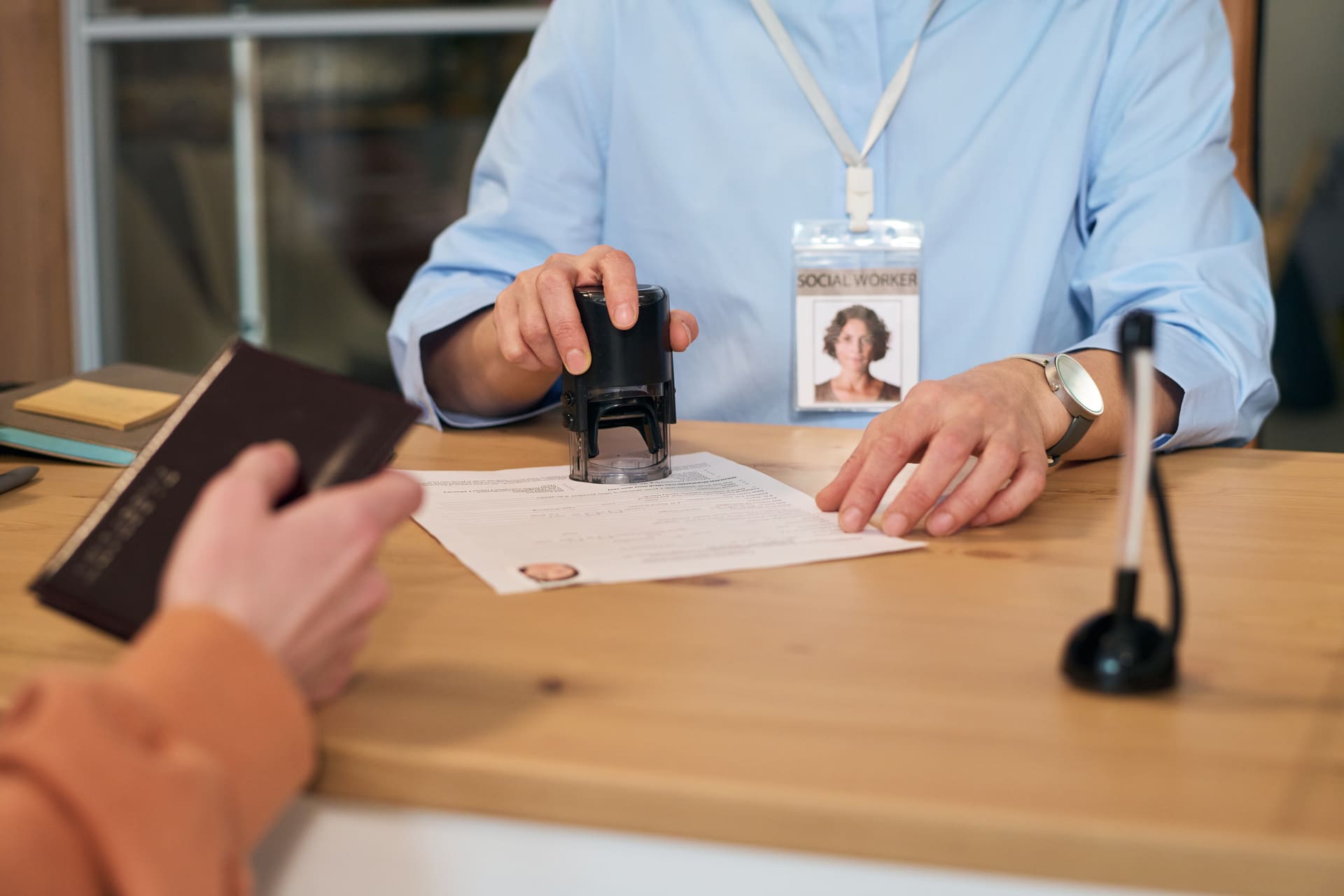
IRCC’s service standard for outland spousal sponsorship processing is approximately 12 months from the date a complete application is received. This includes the assessment of both the sponsorship application (sponsor eligibility) and the permanent residence application (sponsored person eligibility and genuineness of the relationship).
Processing unfolds in stages: IRCC first reviews the sponsor’s eligibility, which typically takes around four months, then the application transfers to the visa office handling the sponsored person’s country for the assessment of permanent residence eligibility, taking approximately six to eight months. A medical examination and biometrics collection are required during this stage.
Processing times can vary significantly depending on the visa office, the completeness of the application, and whether IRCC issues a procedural fairness letter requesting additional information. Current estimates are published on the IRCC website.
If your file has been delayed beyond the standard service window, we can advise on whether a request for an update or further steps are appropriate.
Book a consultation if your application has stalled or you have questions about processing timelines.
In 2023, IRCC extended open work permit (OWP) eligibility to certain outland spousal sponsorship applicants. A sponsored spouse or common-law partner who is living in Canada with their sponsor may apply for an OWP after receiving an Acknowledgement of Receipt (AOR) confirming their permanent residence application is in processing.
To be eligible, the principal applicant must be sponsored by a Canadian citizen or permanent resident residing in Canada, be included in an approved PR application with an AOR from IRCC, and be living in Canada with their sponsor. Dependent children of the sponsored person may also be eligible for an OWP under this policy, provided the principal applicant meets those conditions and the child is also residing in Canada with both the sponsor and the sponsored person.
This eligibility does not apply to applicants living outside Canada while awaiting their visa. It is specifically for those physically present in Canada during the outland processing period, and we can confirm whether a client’s circumstances qualify and assist with the OWP application alongside the sponsorship file.
A refusal by IRCC does not mean the end of the road. One of the most important advantages of filing outland is the right to appeal a refusal to the Immigration Appeal Division (IAD), an independent tribunal within the Immigration and Refugee Board of Canada (IRB).
An IAD spousal appeal is a de novo process, meaning the couple can present their full case from scratch before an independent board member. New evidence can be introduced, witnesses can testify, and the member can assess whether the refusal was correct on the facts, the law, or humanitarian grounds.
The appeal must be filed within 30 days of receiving the refusal decision. Once the appeal record is received from IRCC, typically within 60 days of filing, the disclosure deadline becomes a key procedural milestone.
The Immigration and Refugee Board confirms that the IAD must receive your evidence no later than 60 days after you receive the appeal record.
In some cases, the IAD will pull a file for early resolution before scheduling a full hearing. This is a confidential process where an IAD facilitator brings both sides together to explore whether the appeal can be resolved without proceeding to a hearing.
The decision to settle rests entirely with Minister’s counsel, and counsel can decline without giving reasons.
A failed early resolution is not a setback. If no agreement is reached, the file proceeds to a full hearing.
As Daniel Kingwell describes it, early resolution is “a free kick at the can.” If settlement is reached and approved by a member, the visa post is required to process the application and cannot refuse again on the same ground, for example genuineness of the relationship, unless new contrary evidence arises.
Many couples instinctively consider reapplying after a refusal. In most cases, this is not the right choice when the refusal was on the basis of relationship genuineness.
Reapplying returns the application to the same IRCC decision-making structure, and the refusal remains on the record.
The IAD provides something reapplication cannot: an independent, fresh assessment by a board member who is not the original officer or their supervisor. We advise clients on which path makes sense for their specific circumstances before that decision is made, because the choice between reapplying and appealing has lasting consequences for the file.
There is no formula that guarantees approval, but the foundation of every strong outland sponsorship application is credible, consistent, and well-documented evidence of a genuine relationship. IRCC officers are trained to identify applications where the relationship may have been entered into primarily for immigration purposes rather than for a genuine conjugal, common-law, or marital relationship.
The most common grounds for refusal are:
Strong applications include consistent evidence across multiple categories: communication records, joint finances, travel records, photographs, and statutory declarations from people who know the couple. Where the couple has faced unusual circumstances, a long-distance relationship, barriers to meeting frequently, or family opposition, we help clients explain those circumstances in a way that contextualizes rather than undermines their application.
“Live in the real world. If you’ve got a problem, present it. Be upfront and deal with it.” — Daniel Kingwell, Kingwell Immigration Law
Book a consultation to talk through your application strategy with our team.
Some situations carry heightened risk and benefit from legal advice before the application is filed:
We have represented clients in spousal and conjugal partner sponsorship matters all the way to the Federal Court. In A.H. v Minister of Citizenship and Immigration (2020 FC 530), we acted on an overseas sponsorship of a conjugal partner from Saudi Arabia.
IRCC refused the application on the basis that they did not meet the requirements of conjugal partnership, and the Immigration Appeal Division rejected their appeal. We represented them on appeal to the Federal Court, and the judge overturned the decision, agreeing that the officer and IAD had improperly considered their individual and relationship histories.
Their PR application was returned to IRCC for processing.
The choice between outland and inland sponsorship is one of the most consequential decisions a couple can make, and it is one that is often made without fully grasping what is at stake. The short answer: Outland sponsorship is the default under IRPA, and inland is the exception.
The key difference most couples do not know about is what happens if IRCC refuses the application. If you file inland and IRCC refuses, there is no right of appeal to the Immigration Appeal Division (IAD).
The only option is a Federal Court judicial review, which is a limited process that looks at whether the officer made a legal error, not whether the decision was the right one on the merits.
Filing outland preserves your right to appeal a refusal to the IAD. That is a full, de novo hearing before an independent board member, where new evidence can be submitted and a fresh assessment is made.
It is a fundamentally different and much more substantive process.
Daniel Kingwell, founder of Kingwell Immigration Law, puts it directly: “A bureaucrat gets to decide if I can live with my wife in Canada — which effectively means if the answer is no, I’ve got to leave, and I’ve lived here my whole life.” His own experience with the spousal sponsorship process as a client, not a lawyer, shapes how the firm approaches every sponsorship case it handles.
The practical implication: if there is any meaningful possibility of a refusal, a complicated relationship history, prior immigration issues, or a gap in documentation, filing outland is almost always the more defensible choice. We help couples assess that risk before a single form is filed.
💡 Additional reading: inland vs outland spousal sponsorship in Canada
Outland sponsorship | Inland sponsorship | |
Sponsored person’s location | Living outside Canada (or in Canada choosing outland) | Must be in Canada |
Travel during processing | Sponsored person can travel freely | Travel is not recommended and may affect the application |
IAD appeal right if refused | Yes | No |
Federal Court judicial review if refused | Yes | Yes |
Conjugal partners eligible | Yes | No |
Processing visa office | Visa office in applicant’s country | IRCC centralized in Canada |
At Kingwell Immigration Law, our team is led by Daniel Kingwell, an LSO Certified Specialist in Citizenship and Immigration Law with over 20 years of practice. We handle spousal sponsorship cases at every stage, from initial application strategy through IAD appeal and Federal Court judicial review, for clients across Canada remotely.
The decisions made at the outset of a spousal sponsorship case, whether to file outland or inland, how to structure relationship evidence, and whether to appeal or reapply after a refusal, have lasting consequences. We are here to make sure those decisions are made with a full picture of what is at stake and a clear strategy behind them.
Call us at 416.988.8853 or book a consultation to discuss your sponsorship case.
Yes. Canadian citizens living outside Canada can sponsor a spouse under the outland process, but must show they intend to return to Canada once their partner becomes a permanent resident.
Permanent residents living outside Canada cannot sponsor. Kingwell Immigration Law advises on how to document that intention before filing.
No. Outland sponsorship does not require the sponsored person to have valid temporary status in Canada.
IRCC processes the application through the visa office for the applicant’s country of origin or legal residence. At Kingwell Immigration Law, we confirm the correct visa office before any application is submitted.
A procedural fairness letter means IRCC has concerns and is inviting a response before a final decision is made. At Kingwell Immigration Law, we treat this as one of the most consequential moments in a sponsorship file.
The response must address each concern with specific, credible documentation.
Yes. Canadian immigration law bars sponsors from sponsoring a new spouse within five years of the previous sponsored person becoming a permanent resident.
A prior divorce does not reset this bar. Kingwell Immigration Law advises full disclosure of all prior sponsorships and relationships to avoid misrepresentation findings.
A criminal record does not automatically disqualify a sponsored person under outland spousal sponsorship, but the offence must be assessed against Canadian law before filing. Depending on equivalency and time elapsed, Kingwell Immigration Law may advise criminal rehabilitation, a Temporary Resident Permit, or a humanitarian and compassionate application.